


How does gentle case handling work?
It’s a given that any production company wants to avoid damaged products. They represent wasted resources, a profit loss, and can affect the company’s reputation – and the loss hits all the harder if the damage was entirely preventable. How your boxed products are handled during end-of-line processing is one essential step that you can’t overlook. After all, it’s no fun opening a packet of chips and finding out you’ve only got crumbs: keep your product quality where it ought to be and prevent unnecessary damage by learning all about the art of gentle case handling.
How your packaging plays a role
When dealing with fragile products, such as chips or cookies, you want your product to remain intact and as intended for end consumers. Moreover, some countries or companies have stricter requirements: if the outer packaging is damaged, they will reject the product, even if the inner packaging and product itself remain intact.
It’s in a manufacturer’s best interests to avoid potential damage – but needing to invest in sturdy packaging can equally run up costs. Outer packaging is generally only used for storage and transport, resulting in companies wanting to save money on quality. As a result, these boxes tend to be on the flimsier side, making them more susceptible to damage. Therefore, it’s in their best interests to invest in end-of-line processes such as gentle case handling to save them money over time: a method that can simultaneously deal with fragile packaging and avoid product damage.
Gentle case handling
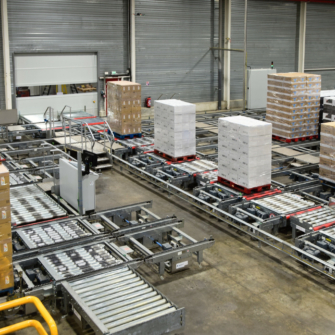
How does it work? The secret lies in handling the cases as little as possible: no pinching, no grabbing, no lifting. When the cases leave the manufacturing line, ready for palletizing, they’re often placed on accumulation tables, sliding from the conveyor to the table. Once enough cases have accumulated for a pallet, they’re then gently pushed to the conveyor belt that brings them to the palletizer.
During their journey, they’re transported with a calm, steady flow. On the conveyor belt, they’re gently laid out in a specific pattern – to match the stacking pattern they’ll follow on the pallet. This happens via rollers underneath the boxes, moving them into the right place, where they are gently nudged to turn in the desired direction.
Curious to see it in action? Watch the video.
Once the boxes are in the right pattern, they’re (gently) pushed together onto a trapdoor. The pallet will be moved to meet the trapdoor as closely as possible, minimizing the distance that they need to fall. When it slides open, the cases are neatly stacked onto the previous boxes – ready for wrapping and transportation.
Damage-free palletizing with Scott
But is it even possible to maintain your palletizing rate if you’re not seeing any robot grippers productively lifting boxes to and fro? Yes – and you’re even able to keep it going at high capacity. By respecting a slow, steady flow from your manufacturing line to your palletizer, your palletizer will be able to maintain its consistent rate of operation.
Gentle case handling is a typical feature of Scott palletizing solutions. Scott’s palletizing roots were founded in the bottling industry, where lines were fully set up to avoid bottles bumping into each other and breaking. Meanwhile, Scott’s gentle handling palletizing solutions have grown to feature all kinds of products – from the heaviest boxes carrying up to 40 kgs of meat to featherlight snacks, but perfected all the same. In fact, for yoghurt producer Savencia Fromage & Dairy, Scott’s gentle case handling was brought to another level, vertically transporting the yoghurt pots to avoid contact between the yoghurt and the lids of the packaging.
This hands-off approach is fully ingrained from the start, as the entire line includes built-in features to touch boxes as little as possible: at no time do the boxes need to be handled, gripped, or lifted. Cases are brought to the palletizer at a gentle pace, matching the palletizing time and the organization’s capacity. The machine is kept entirely open, with cameras monitoring box quality, so that operators can quickly and easily jump in to tape or fix a box that could cause potential damage.
If you’re looking to minimize product damage throughout your end-of-line manufacturing, Scott is the way to go. Work together with experts on finding the best solution for your specific manufacturing needs and find out how your product works with gentle case handling in a test environment.
Get in touch.