

How can Maestro+ improve your end-of-line operations?
Looking to scale your production on a limited budget? Or maybe you want to streamline your operations after spotting too many inefficiencies. And what about those reports management has requested on production downtime? It seems like you’re missing a global overview of how your end-of-line operations are progressing. Find out how Maestro+ keeps everything tracked and in sync – from your ERP all the way down to your packaged product.
Your key to a smoother end-of-line production process
There are so many moving parts to a production process, it’s impossible to keep track of them all – especially if you’re aiming for smooth coordination, full visibility, and precise timings. Looking at your end-of-line set-up, you’ve got your physical machinery on the factory floor: palletizers, wrappers, labellers… hardware that’s separately controlled by its own PLC (programme logic controller). On the other hand, there’s your organization’s ERP, software that controls logistics and transportation. These systems don’t speak the same language.
This is where Maestro+ comes in: a global, connected software system that orchestrates your entire end-of-line process. Working as a translator and a coordinator, Maestro+ sits between your business systems and the physical factory machinery. Its main job is to keep software and hardware working together smoothly, even if they all originate from different suppliers. From the moment a product is boxed through to palletizing, wrapping, labeling, and transportation, Maestro+ makes sure every step is fully traceable and happens in the right order at the right time.
Traceable from start to finish
For industries such as the food and beverage industry, a product’s traceability is especially important. With Maestro+’s Print and Apply function, it’s possible to track the entire path of a product throughout the production line, from its individual packaging to its pallet and warehouse location. An automated system generates a barcode linked to a specific order, product, and lot, which is then labelled on its primary, secondary, and tertiary packaging. For manufacturers that require full product transparency, this system provides the exact status of each batch and enables them to act quickly in the event of product recalls.
Minimize incidents and spot patterns
Another feature that provides full transparency across the end-of-line production process is Maestro+’s Alarms and Events functionality. The moment an incident or unexpected event occurs, this is signalled within Maestro+. Operators receive real-time information about the incident and can pinpoint exactly where it’s located. This data is then collected over time, providing production managers with clear analytics, helping them spot patterns, identify weak points, and optimize their end-of-line process.
Further optimization
The ultimate goal of software such as Maestro+ is to benefit from smoother, more streamlined operations. Although PLCs are excellent at controlling their machines and keeping things running smoothly, Maestro+ works as the actual brain behind the operations as it analyzes performance, tracks both real-time and historical data, and provides a clear overview of the entire process.
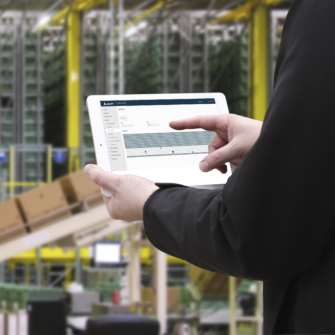
Through the cockpit, operators and production managers can access all these features in a centralized dashboard and create their own analytics reports. They can follow along with how long it takes for a product to move through the end-of-line production, making it easier to identify potential bottlenecks. By analyzing previous data, they can start recognizing patterns that improve or delay the process.
Built for the future
What about future growth? Once your end-of-line production processes are fully optimized thanks to Maestro+, you might be looking towards further expansions or cross-site implementation. Working consistently as a separate software layer, Maestro+ can be easily integrated with your PLCs, ERP, and other third-party equipment – whether this remains in one location or across several plants. Information and data can also be linked, allowing you to gain insights across several production lines and sites.
With Maestro+, you’ve got an accessible solution on your hands that improves visibility, allows full traceability, and provides opportunities for further optimization across your end-of-line operations. Fully compliant with industry standards and with an average implementation timeline of three to six months, you’re looking at an affordable, easily scalable solution to improve your production processes that’s straightforward to use and integrate.
Are you interested in learning how Maestro+ can improve your operations? Get in touch with our team for more information.